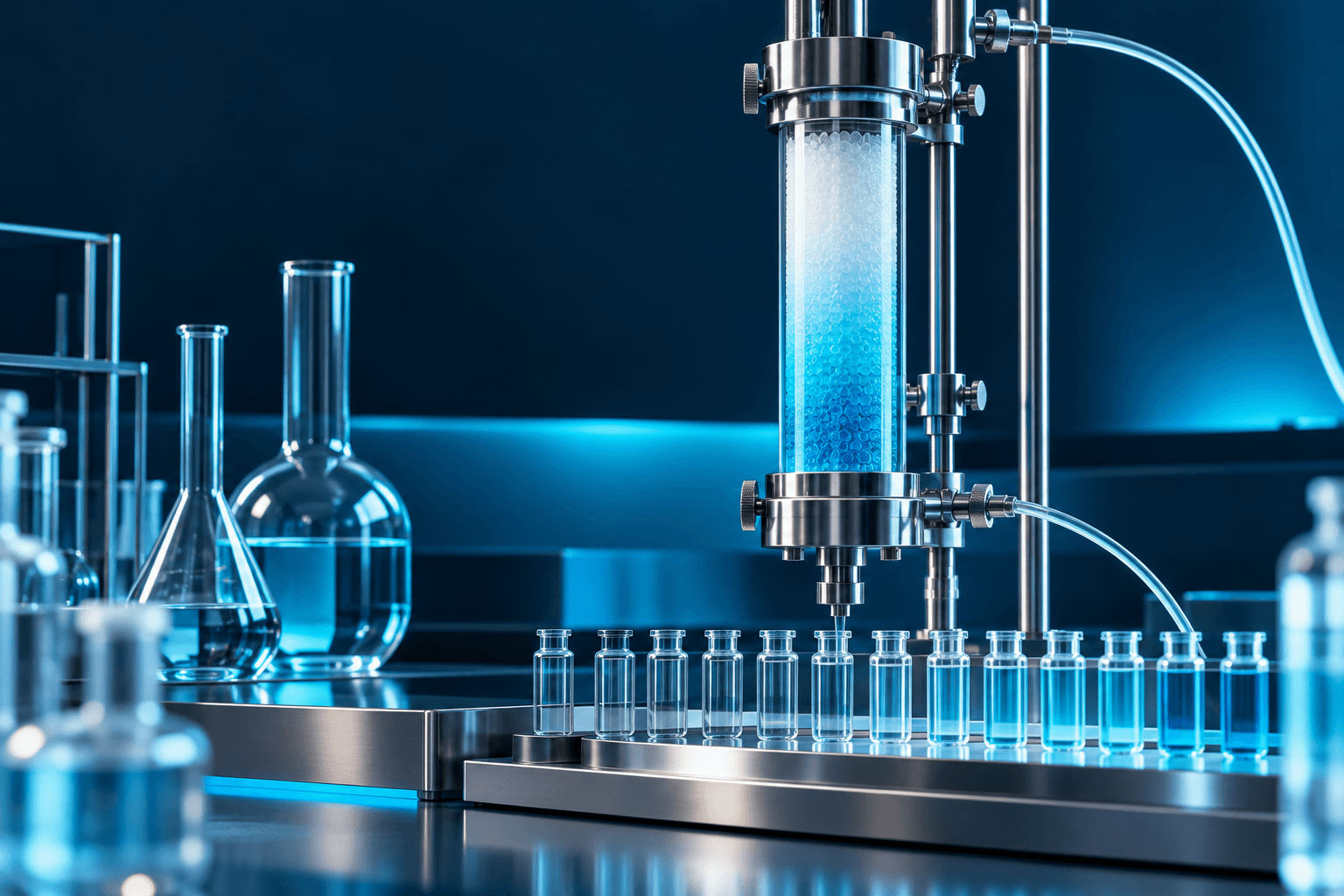
1. Peptide purification
Purification separates a target material from other mixture components. Define the strategy for the sequence and assay purpose. Data must demonstrate success; the technique’s name alone does not.
2. Removing specific impurities
Crude material may contain truncated sequences, reagent residues and by-products. Impurities resembling the target can be especially difficult to separate. We recommend identifying the components requiring control and requesting analytical acceptance criteria.
3. Purification strategies
A strategy may combine methods with different selectivities. We recommend defining each stage’s purpose and assessing yield, purity and material integrity. Extra stages without justification do not demonstrate improvement; evaluate the complete process for the application.
4. Main purification processes
Chromatography can exploit differences in charge, size, affinity or hydrophobicity. These principles do not make every technique suitable for every peptide. The following topics summarise conceptual differences without giving operating conditions.
5. Affinity chromatography (AC)
It uses a specific, reversible interaction between a target and a ligand. Applicability depends on a suitable recognition system. It is not mandatory for every peptide; we recommend justifying the choice for the sample.
6. Ion-exchange chromatography (IEX)
It exploits charge differences and interaction with an oppositely charged phase. pH influences molecular charge. For a study, we recommend documenting why this selectivity suits the target and expected impurities.
7. Hydrophobic-interaction chromatography (HIC)
It separates biomolecules through differences in surface hydrophobicity; salt concentration influences resin interaction. It is frequently used in protein purification. Use with a specific peptide requires assessment rather than automatic extrapolation.
8. Gel filtration (GF)
Also called size-exclusion chromatography, it uses a porous matrix to separate molecules by their size in solution. We recommend checking the column’s separation range before assuming that it distinguishes the target from closely similar components.
9. Reversed-phase chromatography (RPC)
It is a common approach to peptide purification based on differences in interaction with a hydrophobic phase. Fractions are assessed to select material. We recommend distinguishing preparative separation from the analysis used to characterise the result.
10. Compliance with good manufacturing practices (GMP)
GMP covers production, control and a documented quality system. Anvisa issues certificates with defined scopes for establishments. A purification method or purity percentage does not establish GMP; we do not attribute compliance to PeptBio or suppliers without verifiable documentation.
Educational content. It does not replace professional guidance, provide use protocols or establish regulatory authorisation for products.